Morocco Travel Guide: 14 Days From Tangier to the Sahara by Bus
This Morocco travel guide is the exact 14-day route I use: Tangier, Chefchaouen, Fez, the Erg Chebbi dunes, Todra Gorge, Marrakech and Essaouira, all by train, bus and shared grand taxi for $30 to $50 a day. No private drivers, no $900 desert packages, and no riad commissions quietly baked into your costs.
I have crossed Morocco three times in seven years on the road, overpaying badly on the first trip and doing it properly since. This is the street-level version, with real dirham prices. Only have a week? My Morocco itinerary for 7 days covers Marrakech, the Sahara and Fes, and every Morocco guide lives on the Morocco on a budget hub.
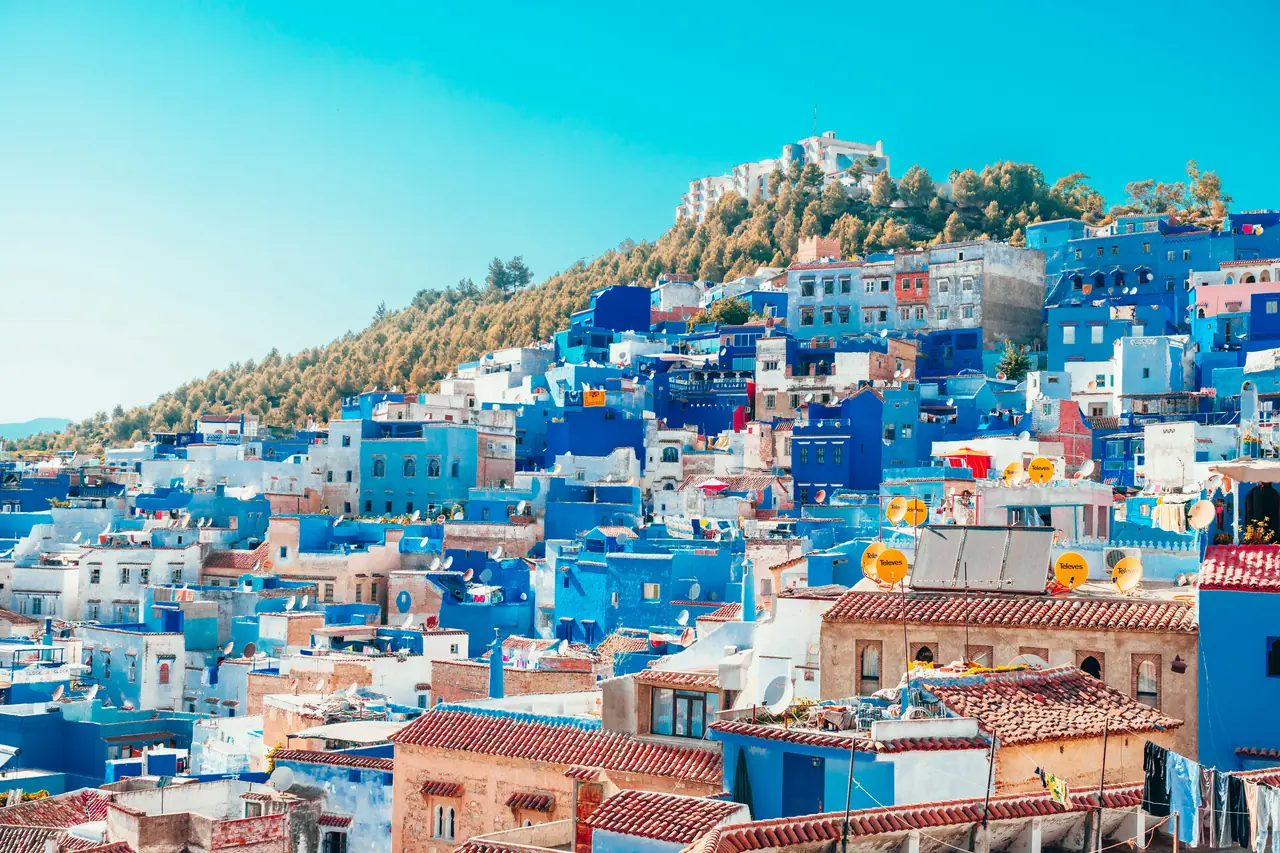
The blue lanes of Chefchaouen, stop two on this Morocco travel guide route.
Morocco Travel Guide Essentials: Money, SIMs and Timing
Every Morocco travel guide tells you to bring cash. Here is how to do it without losing 10% at an exchange booth.
Cash Rules: The Dirham Stays Home
The Moroccan dirham (MAD) is a closed currency, so you cannot properly buy it before you fly. Roughly 10 dirhams equals 1 US dollar. Use bank ATMs in the arrivals hall or Attijariwafa, Bank of Africa and CIH machines in town, and withdraw the maximum each time because home bank fees are usually flat. Train stations, CTM counters and Marjane hypermarkets take cards; souks, taxis, snack stalls and budget riads are cash only.
SIM Cards in Ten Minutes
Maroc Telecom has the best coverage in the Atlas and the desert, while Orange and Inwi are fine in cities. Airport kiosks often hand over the SIM itself for free, and a data recharge big enough for two weeks of maps usually costs under 100 dirhams. Bring your passport, because registration is required.
When to Go and Entry Basics
Spring (March to May) and autumn (late September to November) are the sweet spot. Summer pushes Marrakech and Fez past 40°C, while winter brings freezing desert nights and snow on the Tizi n’Tichka pass. Ramadan shifts about 11 days earlier each year, so check the dates before booking. US, UK, Canadian and EU passport holders currently get 90 days visa-free, but confirm with your own government before you fly.
The 14-Day Morocco Travel Guide Route, Stop by Stop
Run it north to south. Tangier and Chefchaouen are calmer, so you learn to say “la, shukran” (no, thank you) like you mean it before Marrakech tests you.
Days 1 to 2: Tangier
Arrive by plane or on the one-hour ferry from Tarifa in Spain. Walk the Kasbah, drink mint tea at Café Hafa above the Strait, and eat bissara (fava bean soup) for about 10 dirhams. Budget airlines link several Italian airports with Tangier, Fez and Marrakech, so this route pairs brilliantly with my Florence 2 day itinerary.
Days 3 to 4: Chefchaouen
CTM runs Tangier to Chefchaouen in about three hours. Skip the photo queue at the famous blue staircase and hike 30 minutes up to the Spanish Mosque for sunset. On day four, take a shared grand taxi to the Akchour waterfalls with bread and goat cheese from a corner grocer.
Days 5 to 7: Fez
Fez el Bali is a UNESCO World Heritage medina with thousands of lanes and zero logic. Hire an official badge-carrying guide from the tourist office for your first morning, split the fee with your dorm, then explore alone with offline maps. At the Chouara tannery, use any leather shop terrace and leave 10 to 20 dirhams if you do not buy. Any Morocco travel guide selling you a paid tannery tour is wasting your money.
Days 8 to 9: Merzouga and Erg Chebbi
Take the overnight Supratours bus from Fez, roughly nine hours, and save a night of accommodation. Book your camel trek and camp through your Merzouga hostel: a one-night camp with dinner, breakfast and a sunset ride usually runs 300 to 500 dirhams, far below the three-day minibus tours sold in Marrakech.
Days 10 to 11: Todra Gorge and Aït Benhaddou
The Supratours bus toward Marrakech passes Tinghir, Boumalne Dades and Ouarzazate, so break the journey. Sleep near Todra Gorge, then take a shared taxi from Ouarzazate to Aït Benhaddou, the mud-brick ksar from countless desert films.
Days 12 to 14: Marrakech and Essaouira
Cross the Tizi n’Tichka pass by bus, about four hours of hairpins. Sleep inside the medina near Riad Zitoun and hit Jemaa el-Fnaa after dark. With a spare day, Essaouira is three hours away by bus for grilled sardines at the port, paid by weight.
CTM and Supratours seats on the busiest legs sell out, especially on Fridays and Sundays. Buy your onward ticket at the station the evening you arrive. The CTM luggage tag costs 5 to 10 dirhams with a receipt; anyone else demanding money for “loading” your bag is freelancing.
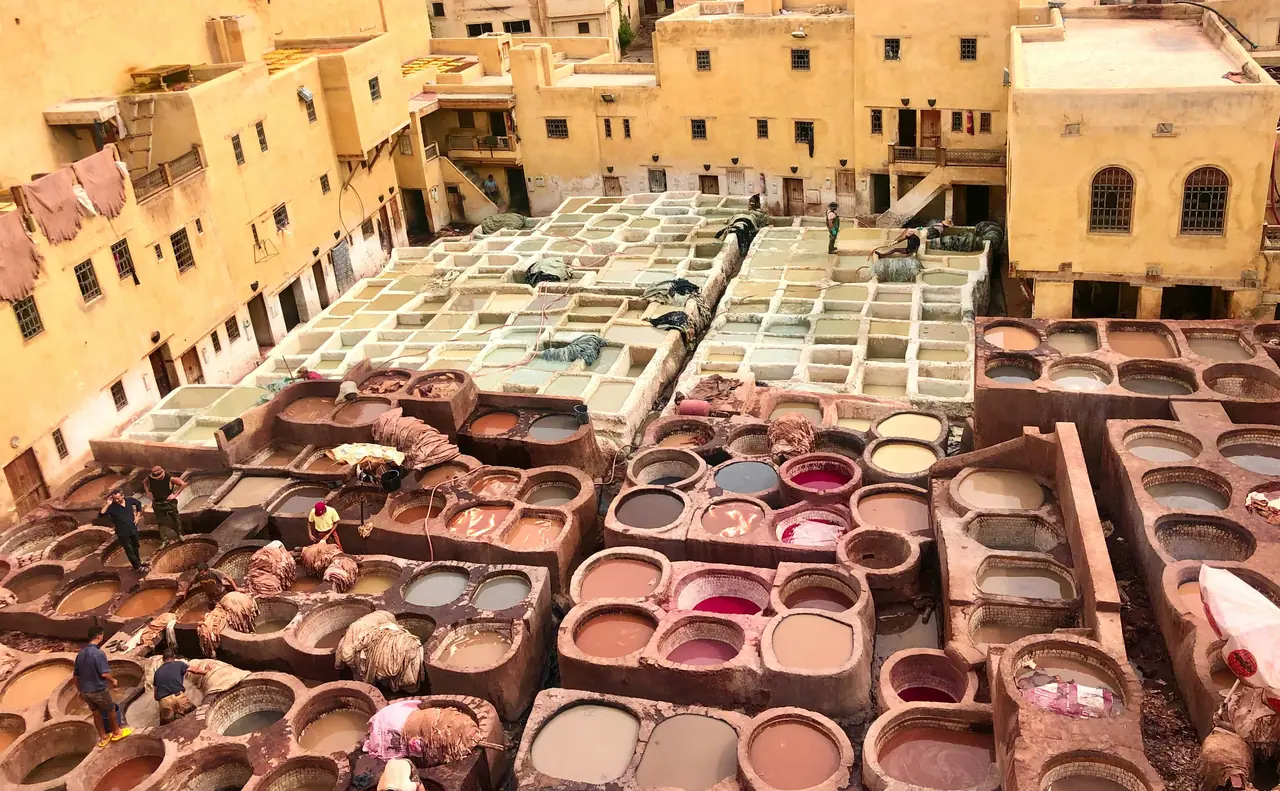
Chouara tannery in Fez, the strongest smell on this Morocco travel guide route.
Trains, CTM Buses and Grand Taxis Compared
ONCF trains cover the north and the Atlantic coast, including the Al Boraq high-speed line from Tangier through Kenitra and Rabat to Casablanca, while buses and shared taxis fill every gap. If you liked the rail-first planning in my Japan 10 day itinerary, it will feel familiar: punctual, cheap in second class and easy to book.
Use this Morocco travel guide table to pick the right ride for each leg. Prices are typical ranges, so confirm at the counter on the day.
| Transport | Best For | Typical Cost | Backpacker Tip |
|---|---|---|---|
| Al Boraq high-speed train | Tangier to Rabat or Casablanca | From about 150 MAD | Book early online; fares climb close to departure. |
| ONCF regular train | Fez, Rabat, Casablanca, Marrakech | 100 to 230 MAD | Second class is fine on daytime runs. |
| CTM bus | Chefchaouen, Fez, Essaouira | 40 to 200 MAD | Air conditioning, fixed timetables, paid luggage tag. |
| Supratours bus | Merzouga and the deep south | 150 to 250 MAD | The night bus to the desert saves a hostel bed. |
| Shared grand taxi | Akchour, Aït Benhaddou, short hops | 10 to 40 MAD per seat | Buy two seats for space on longer rides. |
| Petit taxi | Getting around inside cities | 10 to 30 MAD | Say “compteur, afak” (meter, please) before the car moves. |
Eating and Sleeping on $30 to $50 a Day
The trick is eating where Moroccans eat and cooking once a day. Most hostels have a shared kitchen, and the Turkish discount chain BIM sells pasta, tinned sardines, fresh jben cheese and eggs for a few dirhams. Buy fruit and vegetables by the kilo in the souk. Here is the daily breakdown this Morocco travel guide is built on:
- Dorm bed in a medina hostel or riad: 90 to 150 MAD, often with a rooftop breakfast.
- Street breakfast: msemen flatbread, bissara and mint tea for 15 to 25 MAD.
- Lunch at a local snack bar: chicken tagine or a kefta sandwich for 30 to 50 MAD.
- Dinner from BIM and souk groceries: 25 to 40 MAD.
- Transport averaged across 14 days: 60 to 100 MAD per day.
- Hammam and small tips: 30 to 60 MAD; a neighborhood hammam costs 10 to 20 MAD with your own black soap and kessa glove.
That lands between roughly 250 and 425 dirhams a day, about $25 to $43, leaving room for the desert camp. Never follow a tout who “knows a better place”; riad owners pay them commission.
Medina Survival Rules Every Morocco Travel Guide Should Teach
Violent crime against tourists is rare here. The real threats are small and persistent.
“The road is closed.” A young guy tells you the lane ahead is closed, steers you into a cousin’s shop, then demands a guiding fee. Keep walking and trust your offline map.
Jemaa el-Fnaa extras. Henna women start painting before you agree, snake charmers charge for photos you never took, and food stalls drop unrequested bread and olives onto the bill. Check prices before you sit, and skip the chained monkeys entirely.
Respect earns you space. Covering shoulders and knees cuts hassle for everyone. Solo women report mostly verbal harassment; sunglasses and a firm “la” shut most of it down. Ask before photographing people, and remember non-Muslims cannot enter most mosques, with Casablanca’s Hassan II Mosque the big exception.

Sunset over Erg Chebbi, the payoff moment of this Morocco travel guide.
Morocco Travel Guide FAQ
Yes, for most travelers. Violent crime against tourists is rare; the real issues are touts, overcharging and pickpockets in crowded souks. Keep your phone in a front pocket, say a firm la, shukran, and walk with purpose.
Fourteen days covers the full north to south route in this Morocco travel guide without rushing. With ten days, skip Tangier and Essaouira, fly into Fez and out of Marrakech.
Plan on 300 to 450 dirhams a day, roughly $30 to $45, for a dorm bed, local food and public transport. Add 300 to 500 dirhams once for a desert camp booked in Merzouga.
City tap water is treated, but new bacteria can upset your stomach, so most travelers drink bottled Sidi Ali or carry a filter bottle. Go easy on ice and raw salads for the first few days.
No, but it helps. Moroccans speak Darija and Tamazight, French is common in shops and transport, and English works in tourist areas. Learning salam, shukran and bshhal (how much) earns better prices.
Master Route Verdict
Run this Morocco travel guide north to south and you meet the calm hills first, the medina chaos once you are ready, and the Sahara as the centerpiece. Stick to CTM, Supratours and shared taxis, cook one meal a day, book the desert locally, and two weeks fits comfortably inside $30 to $50 a day.
Save this Morocco travel guide offline and carry small notes. Then head back to the Travel Tricks adventure hub and pick where the backpack goes next.